
Summary
- Social prescribing services
- General Practice
- Acute health services
- Mental health services
- Community services
- Social Care services
- Other Service Providers MAY conform to this information standard.
- Referrers to social prescribing services MAY conform to this standard.
- Care records
- Pharmacy, Medicines and Prescribing
- Referrals
- Community health
- Hospital
- Mental health
- Social care
Contact Point
Documentation
This is an information standard commissioned by NHS England from the Professional Record Standards Body (PRSB) with the intent to establish consistency in information capture regarding social prescribing. Social prescribing helps people to stay well for longer, and is supported by the Government’s loneliness strategy, A connected society: A strategy for tackling loneliness (2018). Social prescribing in the community allows local agencies to refer individuals to link workers, who work with the individual, focusing on ‘what matters to me’ and connecting them with local groups and services. The NHS Long Term Plan commits that personalised care will become “business as usual” for the NHS and for 2.5 million people to benefit by 2023/24. ‘Social prescribing and community based support’ is one of the six components which make up this model and NHS England’s Comprehensive Model of Universal Personalised Care details how this will be achieved, with a target of over 900,000 people being referred to social prescribing schemes by 2023/24. The first version of this information standard is to mandate the use of the PRSB Social Prescribing standard (version 1.0) in appropriate care settings, to achieve consistency of information capture relating to social prescribing activities. This will prepare care providers to be able to share relevant information which will be facilitated through a future version of this standard.
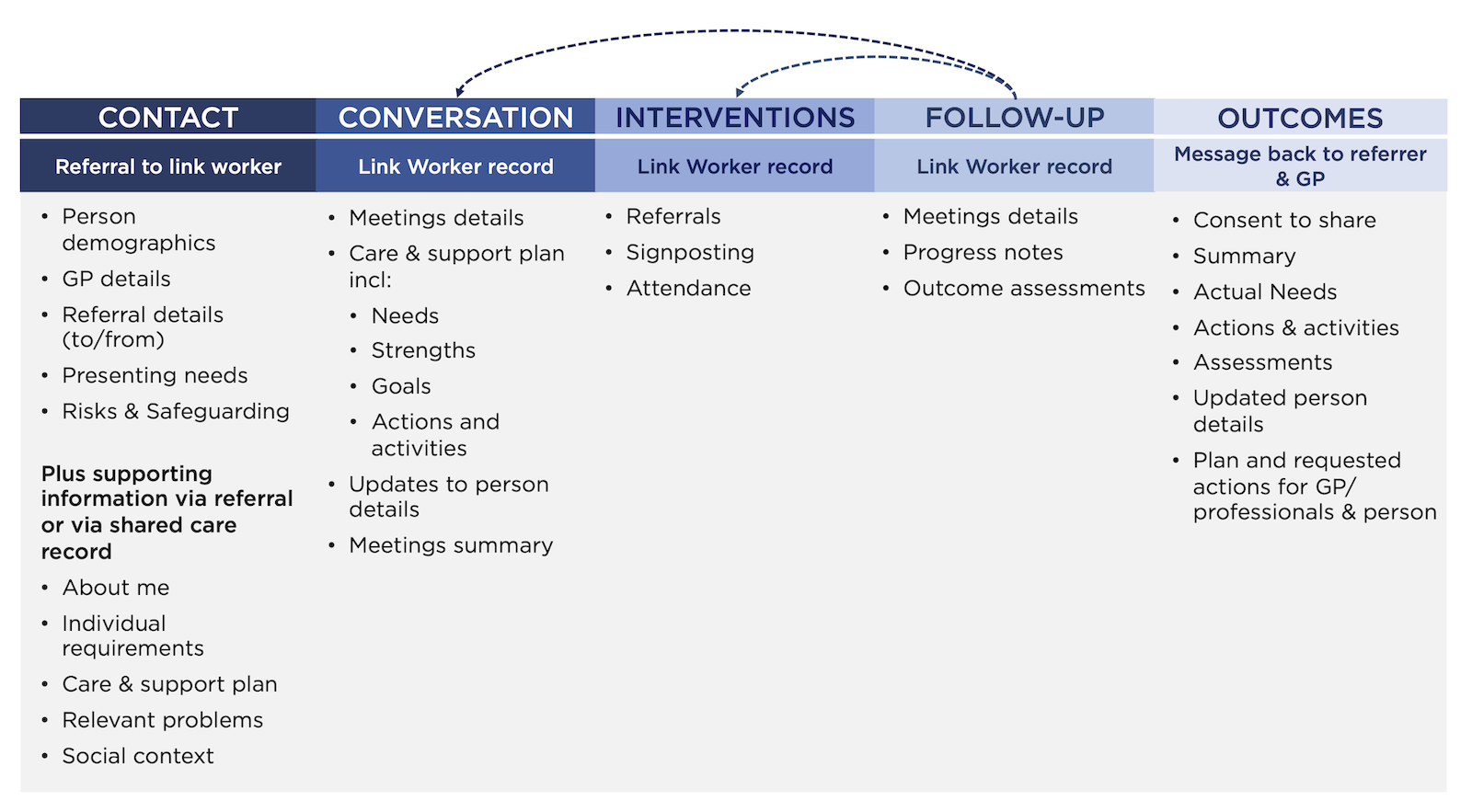
ScopeThe standard is for all models of social prescribing including those used in local authorities and voluntary organisations in social care or health. The standard has three parts:
- The referral to social prescribing (unless it’s a self-referral)
- The link worker’s record
- The message back to the GP and referrer (if different)
- Social prescribing for children and young people. Their particular needs have not been addressed, but it may work or be usable with supplementary information where required.
- Information requirements of any local services the person is referred or signposted to, although where appropriate, they would receive a referral from the link worker.